
The standard advice on cold-emailing VCs is bad. “Keep it short,” “personalize each email,” “focus on traction”, all true and all useless on their own. Generic advice produces generic emails, and generic emails get archived in the first three seconds.
Founders who are actually getting reply rates above 10 percent on cold outreach in 2026 are doing one thing differently: they are running outreach as a structured information operation, not a hopeful blast. The strongest reply rates come from emails built on top of real investor outreach intelligence, research about what each specific partner has actually invested in over the last 90 days, not what their fund’s marketing page says they invest in.
Below are the four frameworks that consistently outperform, the structural rules across all of them, and the data layer that has to sit underneath every send.
Framework 1: The “recent deal” hook
The strongest cold email opens with a specific reference to the partner’s most recent investment in your space. Not “I saw you invest in fintech.” A specific deal, a specific thesis, and a specific bridge to your company.
The structure:
- Reference the specific recent investment by name
- Articulate the underlying thesis you believe led the partner there
- Position your company as adjacent or complementary to that thesis
- Close with a clear, low-friction ask (15-minute call, deck review)
This framework converts at 12 to 18 percent reply rates when executed well. It fails when the founder cannot identify recent investments, which is why the underlying data quality matters so much.
Framework 2: The “data point” hook
The second framework opens with a single non-obvious data point that signals the founder is operating inside the market, not adjacent to it. The data point must be:
- Specific enough that only an operator would know it
- Surprising enough that a partner would want to learn more
- Relevant to the company’s wedge
For founders running this framework, the rest of the email becomes the proof of why this data point matters and how the company is built to exploit it.
Framework 3: The “co-investor signal” hook
The third framework references a fund the partner has co-invested with recently and bridges to your company through that relationship. This works because:
- It shows the founder has done deep investor research
- It signals warm-network proximity even without a formal intro
- It implicitly tees up a syndicate conversation
The structure looks like: “I noticed you co-invested with [Fund] in [Company], we are seeing similar dynamics in [adjacent space] and thought you might find it interesting.”
Framework 4: The “specific question” hook
The fourth framework opens with a specific question that signals genuine curiosity about the partner’s thesis, then bridges to the company. Done well, this avoids the “we’re raising, look at us” framing that feels transactional.
The structure:
- Ask a thoughtful question about a recent investment or public statement
- Add a brief framing of your own perspective that contributes to the question
- Note that you are working on something in the space
- Offer to share more if useful, without pushing for a meeting
This framework gets lower reply rates on average but produces higher-quality conversations when it works.
For deeper construction patterns, see this breakdown on writing a compelling cold email to VCs.
The structural rules across all four frameworks
- Length: 90 to 150 words. Anything longer gets skimmed and abandoned.
- Subject line: specific, not clever. Use the partner’s recent deal or thesis as the subject hook.
- Sign-off: clear identity, one-line credibility marker, link to a deck or memo (not an attachment).
- Tone: direct and operator-fluent, not aspirational or sales-style.
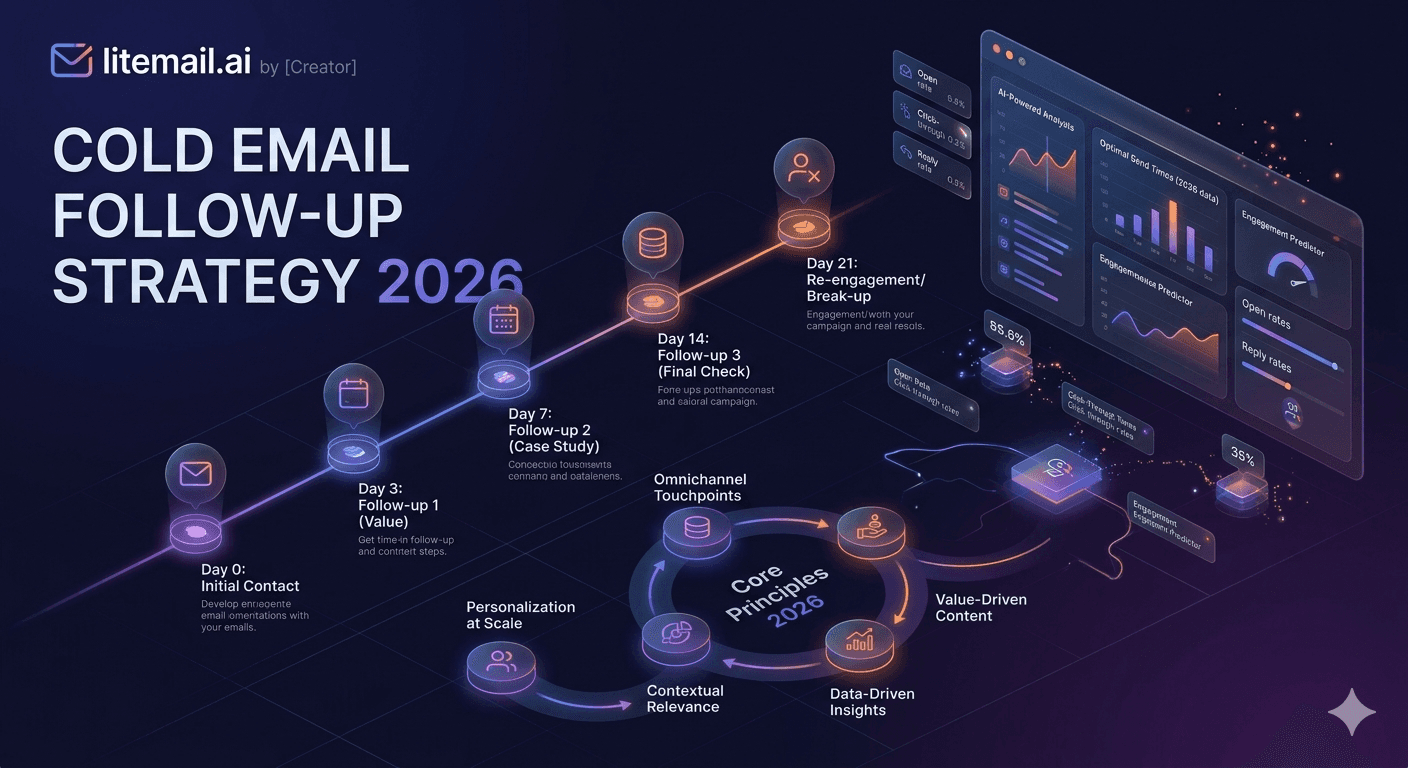
- Follow-up: one follow-up at day 4, one at day 10. After that, drop the partner from active outreach for 60 days.
The 30-second test before you send
Run every cold email through a fast sanity check before it goes out:
- Could this exact email be sent to any other partner unchanged? If yes, it is still too generic.
- Is the recent reference verifiable in 5 seconds? If the partner Googles it and nothing matches, your credibility evaporates.
- Does it survive being read first by a skeptical associate? Most cold emails are pre-screened, not read by the partner directly.
- Is the ask clear and low-friction? “15 minutes for feedback” beats “let’s chat about partnering.”
Founders who run this filter cut their send volume in half and double their reply rates.
The operating system around the email
The email itself is only as good as the workflow behind it. Founders who get high reply rates have:
- A real list of partners (not firms) who have deployed capital in the last 90 days
- A research note on each partner showing their recent thesis and investments
- A tailored opening built from that research
- A tracking system that prevents duplicate sends and manages follow-ups
- A learning loop, what subject lines opened, what framings replied, what got dropped
This is more work than blasting 200 emails. It also produces 20x the meeting volume from the same effort.
The data layer underneath the workflow
The reason cold email reply rates have polarized in 2026, some founders getting 15 percent, most getting under 2 percent, is that the underlying data has polarized. Founders with current information about which partners are deploying capital this quarter, which sectors they are leaning into, and which co-investors they prefer have a structural advantage that generic founders cannot close with effort alone.
To build that advantage, founders need a real-time view of active investors, not a static export from a year-old database. The difference between a database that refreshes quarterly and one that updates continuously is the difference between pitching a partner who has not deployed in 14 months and pitching a partner who closed three deals in the last 90 days. One sends you to spam. The other gets you to a meeting.
The subject line layer
Subject lines deserve their own treatment because they are a binary filter. A weak subject line means the email is never read regardless of how strong the body is. The patterns that work in 2026:
- Reference to a specific recent investment (“re: your investment in [Company]”)
- Specific data point as headline (“[Sector] is seeing [unusual signal]”)
- Direct framing of your wedge (“[X] is breaking, here’s what we’re building”)
- Question framing (“Quick question on your [Sector] thesis”)
For more on subject line testing patterns, see this breakdown of VC email subject line formulas that consistently win opens.
Why generic outreach is finished
Cold email is not dead in venture. Generic cold email is dead. The founders breaking through are running cold email like a structured intelligence operation, built on real-time investor research, tailored to each partner, tracked with the same rigor a sales org would apply to enterprise outbound.
The reply rates are the proof, and the gap between top performers and everyone else is widening every quarter as the data tools improve. Founders who treat outreach as a data discipline win meetings. Founders who treat it as a numbers game keep losing them.
