
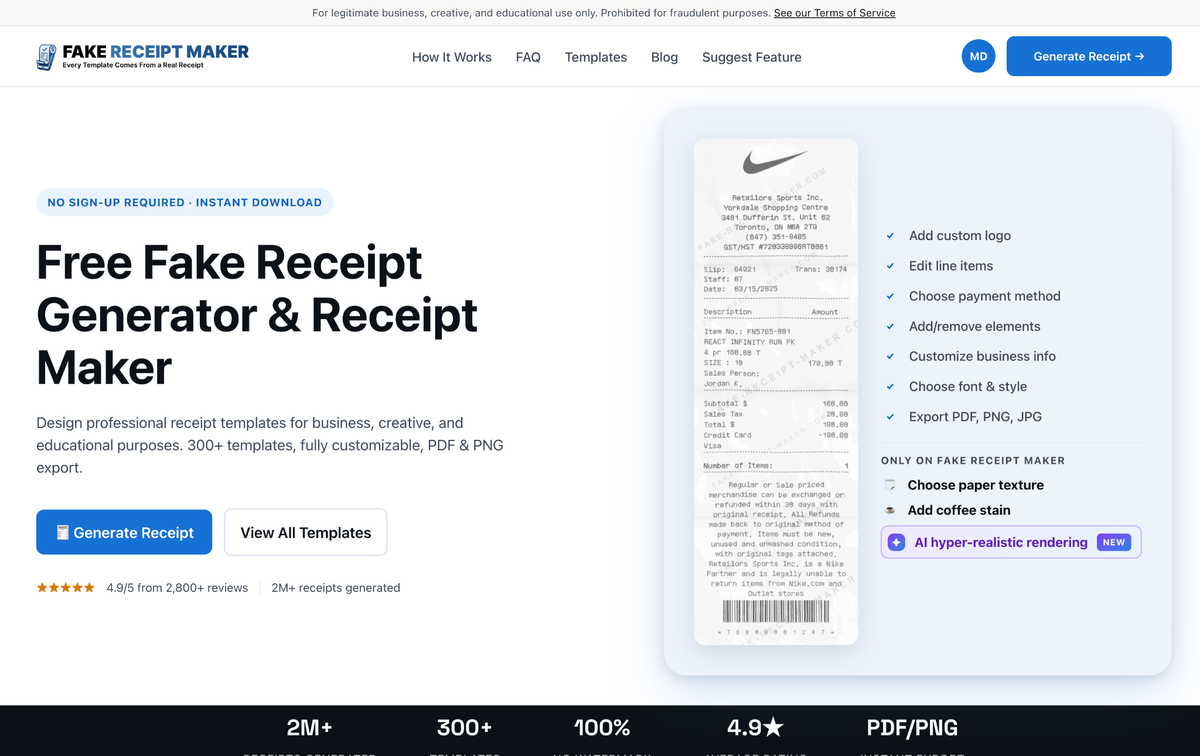
If you have been thinking about how to make a fake receipt for a prop, a mockup, a lesson or a test, you probably have a handful of practical questions before you start. This pulls the most common ones into one place with straight answers, so you know exactly what to expect.
Is it hard to make a fake receipt?
No, not anymore. The hard part used to be building the layout by hand in a design program, getting the font, alignment and barcode right. A modern generator starts from a template reverse engineered from a real receipt, so all of that is already done. You pick a template, edit the details and export. It takes no design skill and, once you have done it once, well under a minute.
How do I make one that actually looks real?
Realism comes down to a few things. Start from an accurate, scan based template so the structure is right. Make sure the math reconciles, which a good tool does automatically. Use a plausible store address, a timestamp within opening hours and prices that fit the date. Match the format to the kind of store. And if the receipt will be seen up close, add physical touches like paper texture and ink variation.
Online Receipt Maker handles most of this for you, with real layout templates, automatic totals and realism options, so the parts that are easy to get wrong are taken care of.
What format should I export?
Pick the format to match where the receipt is going. For most uses, a standard image is the easiest, since it drops straight into a video, a slide, a post or a document and displays everywhere. Choose PDF when you want a crisp, print ready file or you are assembling several receipts into one document, such as a workbook or a handout. For anything that will be printed as a physical prop, export at the highest resolution available so it stays sharp on paper. And if the receipt is destined for an app mockup or a web page, an image at the right dimensions for that layout saves you resizing later. The good tools offer both image and PDF, so you are rarely stuck.
Is it free?
Usually you can do a great deal for free, including browsing templates, editing every field and previewing the result. The common limit is a watermark on free exports, with watermark free output and the most realistic rendering available on paid tiers. For a private, low stakes receipt, free is often enough. For published or professional work, the watermark free version is worth the small cost.
How long does it take?
Once you know the tool, under a minute for a straightforward receipt. The first one might take a few minutes while you find your way around. A batch of varied receipts takes longer, but far less than building each by hand, which is the whole point.
Do I need to download software?
No. The good tools run in your browser, so there is nothing to install and they work on a phone or a laptop equally.
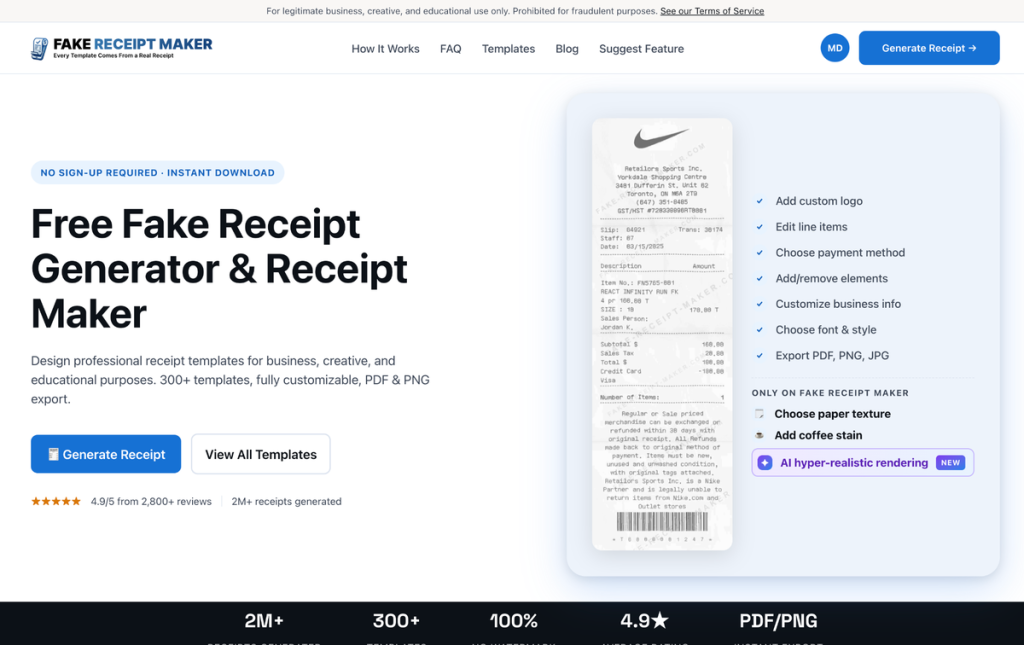
Fake Receipt Maker is a good example of the simplest path, with no sign up, a three step flow and PDF or image export, all in the browser.
What can I edit on the receipt?
Essentially everything: the store name and address, the line items and prices, the date and time, the payment method, the tax rate, the cashier or order number, and often the logo. The totals typically calculate themselves as you edit, so the math stays consistent.
Is making a fake receipt legal?
Making a realistic receipt is legal. Using one to deceive someone in a real financial transaction is not. The tool is fine, the misuse is not. Legitimate purposes, props, mockups, demos, testing, education, novelty and creative work, are entirely above board. Using a fabricated receipt for fraud, like a false expense claim, a bogus return, an insurance claim or tax evasion, is illegal everywhere regardless of how the receipt was made, and reputable tools prohibit it in their terms.
What should I avoid in a tool?
Skip anything that demands your email before you can see the editor, that hides a watermark until after you have done the work, or that offers one generic layout dressed up as many brands. A trustworthy tool shows you exactly what you will get before any money or data changes hands.
A note on legitimate use
To be clear on the one boundary that matters: these tools are for legitimate creative, business, educational and testing work, and both sites say so plainly on their own pages. Making a realistic receipt for those purposes is fine. Using one to deceive anyone in a real transaction is illegal whatever tool produced it, and both services prohibit it.
Bottom line
Making a fake receipt is easy, fast, mostly free and entirely legal for legitimate purposes. Start from an accurate scan based template, keep the math and context plausible, add realism if it will be seen up close, and you will have a believable receipt in under a minute, all in your browser with no design skills. Just keep it to the honest creative and professional uses these tools are built for. Once you have made a couple, the questions tend to fall away, because the process turns out to be far more ordinary than the name suggests, closer to filling in a form than to anything technical or risky. If a question still nags at you, the fastest answer is usually to make one and see for yourself, since a single pass through the editor clears up more than any amount of reading about it ever will.
