
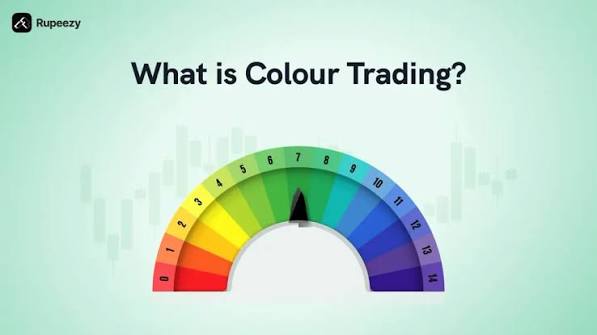
Somewhere in India right now, a phone screen is counting down from thirty. When the timer hits zero, a number between 0 and 9 will appear, a colour will light up, and thousands of people will find out at the same instant whether their prediction was right. This is colour trading — also called colour prediction — and over the past few years it has become one of the most talked-about formats in Indian online gaming. It is also one of the most misunderstood.
The name itself causes confusion. “Trading” suggests markets, analysis, charts. In reality, colour trading has nothing to do with trading in the financial sense. There is no asset, no market movement, no skill of analysis that changes the result. Each round produces a random outcome, and players simply predict which of a small set of colours or numbers that outcome will be. It is a game of chance dressed in the vocabulary of the stock market — and understanding that distinction is the single most useful thing anyone can know before playing.
The Basic Mechanics of a Round
Strip away the branding and every colour prediction game follows the same skeleton. A round opens. Players have a fixed window — often as short as 30 seconds, sometimes as long as several minutes — to place a prediction. The window closes, the result is generated, winners are paid according to fixed multipliers, and the next round opens immediately. There is no daily draw to wait for; rounds run continuously, around the clock.
The most common implementation maps a single digit, 0 through 9, onto colours. Take the Wingo format, the flagship game on most colour prediction platforms. The digits 1, 3, 7 and 9 are Green. The digits 2, 4, 6 and 8 are Red. The digits 0 and 5 are Violet. On top of the colour layer sits a size layer: results from 0 to 4 count as Small, and results from 5 to 9 count as Big. So a single result — say, a 7 — simultaneously resolves several different predictions at once: Green wins, Red loses, Big wins, Small loses, and anyone who picked the exact number 7 wins the largest payout of all.
Payouts are fixed and published. In Wingo, a correct Red or Green prediction typically pays 2x the stake. Big and Small also pay 2x. Violet, which covers only two of the ten digits, pays more — 4.5x — precisely because it wins less often. Predicting the exact number pays up to 9x. Notice the pattern: the rarer the outcome, the higher the multiplier. That is not generosity; it is arithmetic. The payout scales with improbability, which is why no bet type is inherently “better” than another over time.
Why the Format Took Off in India
Colour prediction did not become popular in India by accident. Several forces converged. Cheap smartphones and inexpensive mobile data put a capable gaming device in hundreds of millions of pockets. UPI made moving small amounts of money instant and familiar — the same gesture used to pay a chaiwala could fund a game wallet. And the format itself is almost frictionless: there are no rules to study, no opponents to outplay, no learning curve. A first-time player understands Wingo within one round.
Language played its part as well. Where much of online gaming arrived in India as an English-only product, colour prediction platforms tended to launch with Hindi interfaces and support alongside English from the start — Jai Club, discussed below, runs both — which lowered the barrier for players far beyond the metros. Community channels on Telegram, sharing codes, screenshots and updates, did the rest of the word-of-mouth work.
The pacing matters too. A cricket match takes hours; a colour prediction round takes half a minute. That compression — stake, countdown, result, repeat — delivers a complete arc of anticipation and resolution in less time than it takes to read this paragraph. It is engaging by design, which is exactly why the format deserves to be approached with clear eyes and firm limits. The speed that makes it entertaining also makes it easy to lose track of time and money.
How Jai Club Implements Colour Prediction
To see how these mechanics look on a real platform, consider Jai Club, an India-focused colour prediction platform launched in March 2026. Its core lineup runs five prediction games from a single shared wallet, with Wingo as the centrepiece. Jai Club’s Wingo follows the standard rule set described above — Green on 1, 3, 7, 9; Red on 2, 4, 6, 8; Violet on 0 and 5 — and offers four round speeds: 30 seconds, 1 minute, 3 minutes, and 5 minutes. The minimum bet is ₹10, and stake multiplier buttons (X1 through X100) let players scale a base amount without retyping it. If you want to see how a full platform builds guides, rules pages and walkthroughs around this format, the jai club game guide site documents each game’s mechanics in detail.
Jai Club also enforces a set of restrictions that reveal something about how these games are balanced. Players cannot bet Big and Small in the same round, cannot bet Red and Green together, and cannot cover more than 7 numbers at once. The reason is simple: covering opposite outcomes or nearly the whole number range would let a player guarantee a result while the 2x payout structure quietly taxed them for it. The rules exist to keep every wager a genuine prediction rather than a slow, disguised loss.
Beyond Wingo, the platform runs variations on the same predictive theme. K3 rolls three virtual dice and asks players to predict the sum or pattern, with payouts running from 2x on Big/Small up to 207x for an exact triple. 5D Lottery draws a separate digit for each of five positions labelled A through E. Moto Racing asks players to predict which numbers from 1 to 10 will finish first, second and third, paying 9.8x for an exact position call. Different skins, same underlying idea: fixed odds on a random outcome.
The Blockchain Twist: Verifiable Results
The most interesting recent development in colour prediction is the use of public blockchains to generate results. Jai Club’s TRX Wingo ties each round to a live transaction on the TRON blockchain. The last character of the transaction hash determines the outcome: an even digit (0, 2, 4, 6, 8) resolves as Green, an odd digit (1, 3, 5, 7, 9) as Red. Because TRON transactions are public and immutable, anyone can look up the hash on tronscan.org and confirm the result independently. The platform cannot edit a blockchain record after the fact.
This matters because the oldest and most reasonable objection to colour prediction games is: how do I know the result is not rigged? For standard rounds, players rely on the platform’s published result history — Jai Club shows the last 10 to 20 outcomes in-app — but that is still the platform’s own record. A blockchain-derived result shifts verification outside the operator’s control entirely. It does not change the odds, and it does not make winning more likely. What it changes is auditability, and for a category that has attracted its share of scam operators, that is a meaningful distinction.
The Money Side, Briefly
Colour trading platforms in India generally run on UPI rails, and Jai Club is typical: deposits start at ₹100 through QR-based UPI channels and credit instantly, while withdrawals run from ₹1,000 to ₹50,000 per transaction, paid to the player’s own bank account or UPI ID, usually within 5 minutes to 24 hours. One rule worth knowing before you ever deposit: withdrawals require your active bet balance to be zero, so money staked in an open round cannot be pulled out mid-play. The practical advice most guides give — including the jai club game resource — is to test any platform with a small withdrawal early, before committing anything you would mind losing.
What Colour Trading Is Not
It is worth ending where we began: with the word “trading.” No pattern-reading, chart-watching or streak-tracking changes the probability of the next result. A Wingo round that has come up Red five times in a row is no more likely to come up Green on the sixth — each round is independent, and the multipliers are set so that the house retains an edge across every bet type. Anyone selling a “guaranteed colour trading strategy” is selling fiction. The honest way to think about colour prediction is as paid entertainment with a chance-based outcome, priced per round, where the long-run cost is built into the payout table.
Legality adds another layer of caution. Real-money gaming law in India varies by state, and platforms in this category operate as international services rather than under an Indian licence. Every player carries the responsibility of checking the rules where they live.
Approached that way — with limits set in advance, stakes kept small, and zero expectation of profit — colour trading is a comprehensible, even elegant little format: ten digits, three colours, one countdown. Approached as an income plan, it is a mistake with a timer attached.
Colour prediction games are strictly for players aged 18 and above. Outcomes are random, and losses are always possible. Set a budget before you play, never chase losses, and if gaming stops feeling like entertainment, step away and seek support.
